
Criteria for Proper Weir Design
The sharp-crested weir is probably the most common open channel primary device we find for measuring flow. It is basic, and usually, the least expensive design option.
While most weir installations we encounter do perform well, they are too often outdated, misapplied, or not maintained for present flow conditions. Many of our customers are surprised to know that there are 13 design requirements for weirs.
The following general weir design requirements apply to all types to ensure accurate discharge measurement:
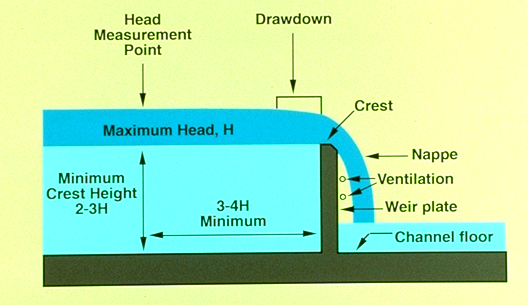
- The weir should consist of a thin plate 1/8 to 1/4 inch (3 to 6 mm) thick with a straight edge or a thicker plate with downstream chamfered edge. The upstream sharp edge prevents the nappe from adhering to the crest. Knife edges should be avoided because they are difficult to maintain. However, the upstream edge of the weir must be sharp with right angle corners, since rounded edges will decrease the head for a given flow rate.
- The upstream face of the weir should be smooth and perpendicular to the axis of the channel in both horizontal and vertical directions. The crest of the weir should also be exactly level to insure a uniform depth of flow.
- The connection of the weir to the channel should be waterproof. Therefore, the joint between the weir plate and channel should be packed with chemically inert cement or asphalt type roofing compound.
- The length of the weir crest or the notch angle must be accurately determined, because the percentage error in measured flow rate will be proportional to the error in determining these dimensions.
- The weir should be ventilated, if necessary, to prevent a vacuum from forming on the underside of the nappe.
- The height of the weir from the bottom of the channel to the crest should be at least 2 times the maximum expected head of liquid above the crest. This is necessary to lower the velocity of approach. The weir height should never be less than 1 foot (0.3 m).
- The approach section should be straight upstream from the weir for a distance of at least 20 times the maximum expected head of liquid, and should have little or no slope.
- The crest must be set higher than the maximum downstream elevation of the water surface. Otherwise, a submerged flow condition will occur instead the free flow condition required for reliable flow measurement.
- The device for the head (flow meter) should be placed at a distance of at least 3 times the maximum expected head on the weir and should be located in a quiet section of the channel away from all disturbances, preferably in a stilling well. Also, the zero point of the head measuring device must be set exactly with the weir crest.
- The crest of the weir must be kept clean. Fibers, stringy materials and larger particles tend to cling to the crest and should be removed periodically. The upstream side of the weir should be periodically purged of accumulated silt and solids.
- The weir size should be selected only after preliminary studies have determined the expected flow rates in the channel in question.
- The cross sectional area of the approach channel should be at least 8 times that of the nappe at the crest for a distance upstream of 15 to 20 times the head on the crest. This is necessary to minimize the velocity of approach. The approach channel should also permit the liquid to approach the weir in a smooth stream free from turbulence, and the velocity should be uniformly distributed over the channel; this may be accomplished through the use of baffle plates if necessary.
- If the weir pool is smaller than defined by the above criteria, the velocity of approach may be too high and the head reading too low. Weirs should be installed and maintained to make the velocity of approach negligible. Appropriate corrections should be made where this is not possible.
Source: ISCO Open Channel Flow Measurement Handbook 6th Edition
Learn more about Open Channel Flow Measurement at the Resource Center section of our Website
To request a free ISCO Open Channel Flow Measurement Handbook, please contact your local representative.
To learn more about weirs, visit our Plasti-Fab page.